
Happy Halloween, Culver City! 🎃
I hope you have a fabulously spooky night.
Fear is great for haunted houses. It's not a great way to choose a City Council.
In just 3 days, we'll decide the future of our town.
So I've shared my final thoughts on the race in the Culver Crescent in a new op-ed: what we've accomplished together, and why Freddy Puza and Thomas Aujero Small have earned my vote.
Polls close Tuesday, so get those ballots in! 🗳️
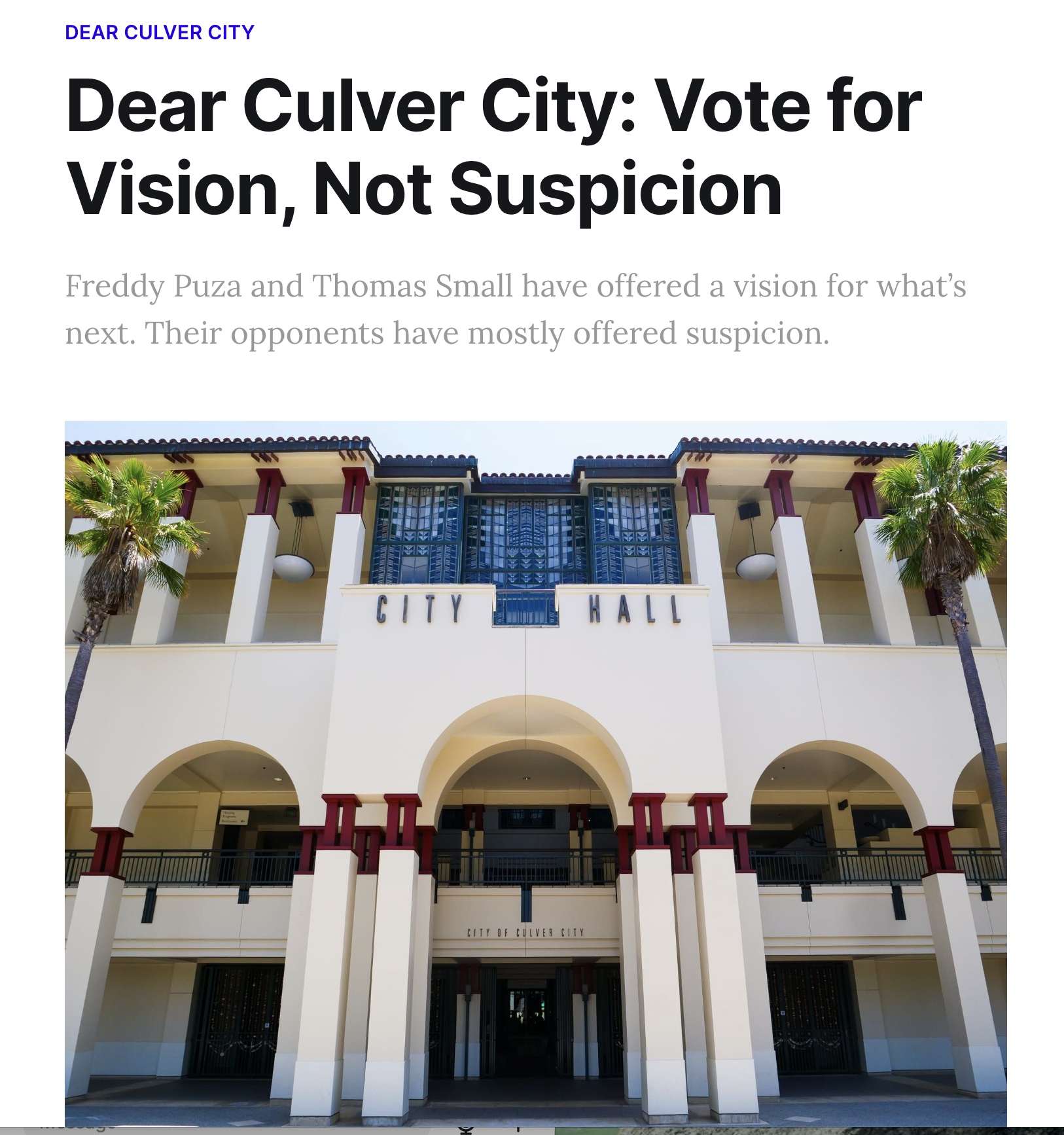
Freddy Puza and Thomas Small have offered a vision for what’s next. Their opponents have mostly offered suspicion.
When I ran for City Council two years ago, I promised to tackle our shortage of affordable housing, make it easier to get around, and approach public safety with an emphasis on prevention over reaction.
There is still a lot of work ahead, but the progress we’ve made on these issues is real.
We have more affordable homes in our pipeline now than at any point in our city's history.
Culver City was the only city in LA County to earn California's Prohousing Designation this year, netting us a $750,000 award from the state to create even more affordable housing and moving us to the front of the line for more state funding.
Thanks to our city’s investments in housing solutions, homelessness in Culver City fell for the fifth year in a row. Our 2026 count found 74 people, down from 240 in 2021 — a nearly 70% drop — in a year when homelessness rose across LA County.
And in spite of what former U.S. Attorney General Pam Bondi spouted about our town, crime fell in 2024 and continued falling in 2025.
Residents are noticing the progress: a recent FM3 Research poll found Culver City voters believe the city is on the right track by a nearly 2-to-1 margin, a 14 point increase since I started on Council.
Of course, none of this was accomplished alone. It happened because I was lucky to serve alongside colleagues with a vision for the future and a willingness to work together on proven solutions.
With Election Day on Tuesday, the question of who will represent us on the City Council for the next four years is an incredibly consequential one for our community.
For me, it’s clear there are two candidates who would continue our progress towards a more affordable, accessible, and safe Culver City.
Freddy Puza and Thomas Small
Mayor Freddy Puza has made affordability his focus — and that is exactly where voters are focused. Californians consistently name cost of living as the most important issue facing the state, and 65% of likely voters say a candidate's position on affordability is very important to their vote. Listening to residents’ concerns, Freddy created the Council's first affordable housing subcommittee and has backed the city's investments in homes working people can afford.
He’s tackled basic quality of life issues, too. The Fiscal Year 2026–27 budget adopted during his mayorship triples our annual rate of sidewalk repair, doubles our annual rate of street repaving, adds to our tree canopy, and begins badly needed repairs to Bill Botts Field and other improvements to our parks system.
Under Freddy’s leadership and working with our City Manager, the Council passed the city's first balanced budget in four years. And by financing major capital projects with bonds over their useful life, we can finally take on infrastructure that has sat on the back burner for decades.
Freddy has also championed safer streets and made it easier to get around without sitting in traffic, he has stood up for our immigrant neighbors against ICE, and he broke barriers as the first openly LGBTQ+ member of our City Council.
Former Mayor Thomas Small's record is just as strong. He helped pass the plan to end oil drilling in Culver City's portion of the Inglewood Oil Field, passed the city's first renter protections, and made Culver City a sanctuary city that does not collaborate with ICE. He helped draft Measure RE, the real estate transfer tax that brings millions in revenues for essential services to the city each year. And he set our first major complete streets projects in motion, giving people new ways to get around town.
But a record is only half the story. Elections are about what comes next.
Thomas and Freddy have both called for a review of the city's contract with Flock, the national license-plate surveillance network, to protect civil liberties — especially for immigrant neighbors who have been targeted by ICE. Both have committed to seeing our street safety projects through. And both have repeatedly committed to building on, not retreating from, our investments in affordable housing.
They share a clear, cogent vision for the future of Culver City.
A different kind of campaign
Jeannine Wisnosky Stehlin and Kimberley Griffin have put themselves on an opposing slate. Accordingly, they offer something different: less a vision for the future, and more so a suspicion of the present.
Ms. Wisnosky Stehlin has given real time to this city, including eight years of service on the Cultural Affairs Commission and a long and commendably consistent history of showing up and speaking at City Hall. Notably however, her campaign appears to rely on manufacturing suspicion about the current Council.
Her campaign’s recent mailer and social media post claims that “outside lobbyists are changing Culver City” and "we don't know who they are." That is a serious charge. Which lobbyists are making which decisions? An accusation of backroom influence should come with at least one example.
Her interest in a lobbyist registry has merit, which is why the Council unanimously directed staff to move one forward last year.
But her vague concerns about outside money influencing the city would land better if it were not so plainly a double standard.
In 2024, two independent expenditure committees raised about $360,000 to back a slate of City Council candidates that included Ms. Wisnosky Stehlin, and essentially all of it came from real estate interests: six real estate companies, led by $199,000 from Hackman Capital Partners, plus the Apartment Association of Greater Los Angeles and the state realtors’ PAC. [NetFile filings]
The larger committee called itself “Our Culver City,” a name eerily close to the local grassroots group Our Culver in a clear attempt to confuse voters, raising alarms about the flood of outside spending in the race.
Candidates cannot control independent expenditures. But a campaign built on warnings about outside interests owes voters some acknowledgment of the interests that spent so heavily on her behalf just two years ago.
As for the "outside interests" her posts allude to: Freddy and Thomas are endorsed by labor unions — some of which have endorsed her as well — plus the Sierra Club, and regional groups working to address our housing and climate crises, none of which are supporting Ms. Wisnoski Stehlin. Our housing crisis and climate crisis aren't outside interests. They are Culver City's interests. And it’s telling that Ms. Wisnoski Stehlin doesn’t share them.
While Ms. Wisnosky Stehlin is focused on supposed outside lobbyists, Ms. Griffin has largely relied on sending residents misleading mailers warning "Don't let them create gridlock!" and claiming the Better Overland project is being pushed by the “out of town bike lobby” and will eliminate "nearly all the parking" and "critical turn lanes," none of which is accurate. The misinformation effort that Ms. Griffin’s campaign is perpetuating has already been thoroughly debunked. In fact, the design the Council approved keeps the center turn lane, two travel lanes in each direction, and parking on the east side.
Instead of sticking to the facts, Ms. Griffin’s campaign has stoked outrage at proposed solutions without suggesting any alternatives.
Listening and leading
Both Wisnosky Stehlin’s and Griffin’s campaigns lean on the same message: City Hall isn't listening and something untoward is happening, but the specifics never arrive.
Listening is a cornerstone of good leadership, but it isn't the whole job. If it were, we would make a decision one week and reverse it the next, after hearing from whoever disagreed. A leader's job is to listen, weigh the evidence, do what's best for the whole community — and then explain why, while being open to change if new information is presented.
Running for office is hard, and anyone willing to put their name on the ballot in this climate deserves credit. But all of us owe voters the facts, not rumors or appeals to unsubstantiated fears. Part of listening to a community is correcting the record when misinformation spreads.
The future is on the ballot
Thomas and Freddy have told us what they want Culver City to become: more homes that people can actually afford, more safe ways to get around, more childcare, better parks, an expanded mobile crisis team, and protection for our immigrant neighbors and our most fundamental freedoms.
That is a more connected, more affordable, more welcoming city. It's a future worth voting for.
Bubba Fish is Vice Mayor of Culver City. Title for identification purposes only.